We use cookies to understand how you use our site and to improve your experience.
This includes personalizing content and advertising.
By pressing "Accept All" or closing out of this banner, you consent to the use of all cookies and similar technologies and the sharing of information they collect with third parties.
You can reject marketing cookies by pressing "Deny Optional," but we still use essential, performance, and functional cookies.
In addition, whether you "Accept All," Deny Optional," click the X or otherwise continue to use the site, you accept our Privacy Policy and Terms of Service, revised from time to time.
You are being directed to ZacksTrade, a division of LBMZ Securities and licensed broker-dealer. ZacksTrade and Zacks.com are separate companies. The web link between the two companies is not a solicitation or offer to invest in a particular security or type of security. ZacksTrade does not endorse or adopt any particular investment strategy, any analyst opinion/rating/report or any approach to evaluating individual securities.
If you wish to go to ZacksTrade, click OK. If you do not, click Cancel.
Airline stocks have long been among the market’s most cyclical and, at times, most rewarding investments.
The industry includes U.S. carriers, low-cost operators, international carriers and cargo-focused airlines.
Top airline stocks to buy now include GXO, DAL and CPA.
Airline stocks have long been among the market’s most cyclical and, at times, most rewarding investments. When economic growth accelerates, leisure and business travel tend to follow, lifting passenger volumes and improving pricing power. As global travel patterns normalize and international routes expand, many investors are revisiting the sector in search of durable opportunities.
The airline industry spans a wide range of business models. It includes major U.S. network carriers, ultra-low-cost operators built around price leadership, international flag carriers, and cargo-focused airlines tied to global trade flows. Each group carries its own mix of risks and potential returns. Understanding those differences is essential before committing capital.
Are airline stocks a good investment?
Airlines can generate meaningful gains during economic expansions, when high load factors and stronger fare pricing support revenue growth. Large carriers such as Delta Air Lines and United Airlines Holdings have historically benefited from rising passenger demand, particularly in premium and long-haul segments.
At the same time, airlines remain capital-intensive businesses that operate on relatively thin margins. Fuel costs are volatile, labor contracts can pressure expenses, and demand is closely linked to broader economic conditions. These dynamics make airline stocks better suited for investors who can tolerate cyclical swings rather than those seeking defensive stability.
In short, airline stocks can be compelling during demand upcycles, but they are rarely considered safe havens.
Below, we examine and rank leading airline stocks using a blend of Zacks Rank signals, Style Scores, and key fundamental metrics to help identify companies that may offer attractive long-term potential.
This is our short term rating system that serves as a timeliness indicator for stocks over the next 1 to 3 months. How good is it? See rankings and related performance below.
The Zacks Industry Rank assigns a rating to each of the 265 X (Expanded) Industries based on their average Zacks Rank.
An industry with a larger percentage of Zacks Rank #1's and #2's will have a better average Zacks Rank than one with a larger percentage of Zacks Rank #4's and #5's.
The industry with the best average Zacks Rank would be considered the top industry (1 out of 265), which would place it in the top 1% of Zacks Ranked Industries. The industry with the worst average Zacks Rank (265 out of 265) would place in the bottom 1%.
The Zacks Sector Rank assigns a rating to each of the 16 Sectors based on their average Zacks Rank.
A sector with a larger percentage of Zacks Rank #1's and #2's will have a better average Zacks Rank than one with a larger percentage of Zacks Rank #4's and #5's.
The sector with the best average Zacks Rank would be considered the top sector (1 out of 16), which would place it in the top 1% of Zacks Ranked Sectors. The sector with the worst average Zacks Rank (16 out of 16) would place in the bottom 1%.
The Style Scores are a complementary set of indicators to use alongside the Zacks Rank. It allows the user to better focus on the stocks that are the best fit for his or her personal trading style.
The scores are based on the trading styles of Value, Growth, and Momentum. There's also a VGM Score ('V' for Value, 'G' for Growth and 'M' for Momentum), which combines the weighted average of the individual style scores into one score.
Value ScoreA
Growth ScoreA
Momentum ScoreA
VGM ScoreA
Within each Score, stocks are graded into five groups: A, B, C, D and F. As you might remember from your school days, an A, is better than a B; a B is better than a C; a C is better than a D; and a D is better than an F.
As an investor, you want to buy stocks with the highest probability of success. That means you want to buy stocks with a Zacks Rank #1 or #2, Strong Buy or Buy, which also has a Score of an A or a B in your personal trading style.
Zacks Earnings ESP (Expected Surprise Prediction) looks to find companies that have recently seen positive earnings estimate revision activity. The idea is that more recent information is, generally speaking, more accurate and can be a better predictor of the future, which can give investors an advantage in earnings season.
The technique has proven to be very useful for finding positive surprises. In fact, when combining a Zacks Rank #3 or better and a positive Earnings ESP, stocks produced a positive surprise 70% of the time, while they also saw 28.3% annual returns on average, according to our 10 year backtest.
GXO designs and operates technologically advanced logistics solutions worldwide, offering airline investors exposure to aerospace and defense supply chain demand. Contract wins, outsourcing conversions and sites built for customer growth should support future revenue contribution, while strategic growth sectors and automation leadership may reinforce long-term expansion. Updated 2026 guidance points to organic growth, EBITDA improvement and cash conversion ahead.
Potential Risks
Execution could suffer if economic conditions, labor shortages, pricing pressure, customer spending, Wincanton integration, indebtedness, trade-policy changes or technology-system failures limit growth or cash generation.
Forecast
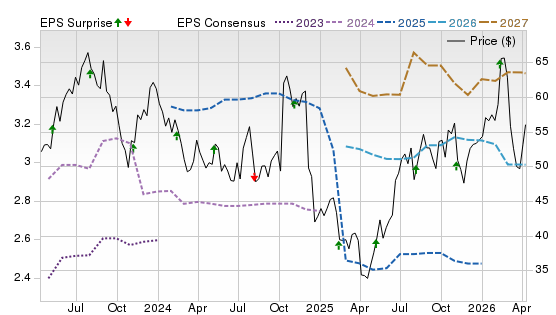
A Zacks Rank #3 (Hold) with B scores for Value, Growth and Momentum points to a balanced setup rather than a table-pounding call. The chart shows price recovering with several recent beats, while 2026 EPS estimates dipped sharply before stabilizing and 2027–2028 lines trend higher. That pattern supports patience. The upside depends on a cleaner estimate momentum and continued cash conversion.
This is our short term rating system that serves as a timeliness indicator for stocks over the next 1 to 3 months. How good is it? See rankings and related performance below.
The Zacks Industry Rank assigns a rating to each of the 265 X (Expanded) Industries based on their average Zacks Rank.
An industry with a larger percentage of Zacks Rank #1's and #2's will have a better average Zacks Rank than one with a larger percentage of Zacks Rank #4's and #5's.
The industry with the best average Zacks Rank would be considered the top industry (1 out of 265), which would place it in the top 1% of Zacks Ranked Industries. The industry with the worst average Zacks Rank (265 out of 265) would place in the bottom 1%.
The Zacks Sector Rank assigns a rating to each of the 16 Sectors based on their average Zacks Rank.
A sector with a larger percentage of Zacks Rank #1's and #2's will have a better average Zacks Rank than one with a larger percentage of Zacks Rank #4's and #5's.
The sector with the best average Zacks Rank would be considered the top sector (1 out of 16), which would place it in the top 1% of Zacks Ranked Sectors. The sector with the worst average Zacks Rank (16 out of 16) would place in the bottom 1%.
The Style Scores are a complementary set of indicators to use alongside the Zacks Rank. It allows the user to better focus on the stocks that are the best fit for his or her personal trading style.
The scores are based on the trading styles of Value, Growth, and Momentum. There's also a VGM Score ('V' for Value, 'G' for Growth and 'M' for Momentum), which combines the weighted average of the individual style scores into one score.
Value ScoreA
Growth ScoreA
Momentum ScoreA
VGM ScoreA
Within each Score, stocks are graded into five groups: A, B, C, D and F. As you might remember from your school days, an A, is better than a B; a B is better than a C; a C is better than a D; and a D is better than an F.
As an investor, you want to buy stocks with the highest probability of success. That means you want to buy stocks with a Zacks Rank #1 or #2, Strong Buy or Buy, which also has a Score of an A or a B in your personal trading style.
Zacks Earnings ESP (Expected Surprise Prediction) looks to find companies that have recently seen positive earnings estimate revision activity. The idea is that more recent information is, generally speaking, more accurate and can be a better predictor of the future, which can give investors an advantage in earnings season.
The technique has proven to be very useful for finding positive surprises. In fact, when combining a Zacks Rank #3 or better and a positive Earnings ESP, stocks produced a positive surprise 70% of the time, while they also saw 28.3% annual returns on average, according to our 10 year backtest.
Market Cap:$50.24 B $54.04 B (Large Cap)(Large Cap)
Projected EPS Growth:-7.73%
Last Quarter EPS Growth:-58.71%
Last EPS Surprise:4.92%
Next EPS Report Date:July 9, 2026
Our Take:
Reasons to Buy
Delta Air Lines runs a global airline built around premium travel, loyalty partnerships and operational scale. Looking ahead, sustained brand strength, high-margin premium offerings, co-brand growth, disciplined reinvestment and balance-sheet flexibility should support margin expansion, free cash flow and shareholder returns. Management targets mid-teens operating margin, more than 15% ROIC, $3 to $5 billion annual free cash flow and 10% EPS growth over time.
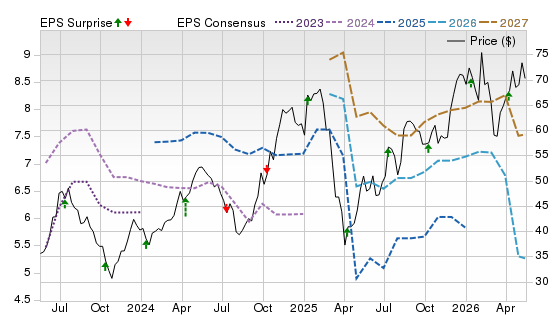
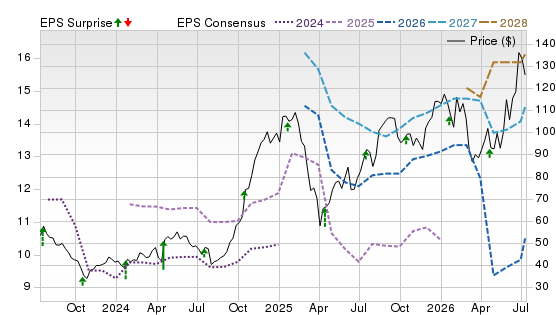
A Zacks Rank #3 and A Value score, paired with B Growth and Momentum scores, suggest attractive valuation but only moderate revision strength. The chart shows a strong price uptrend, mostly positive recent surprises and 2026–2028 EPS estimates moving higher, even as one near-term estimate line wobbles. The setup favors continued outperformance if premium demand keeps estimates rising.
This is our short term rating system that serves as a timeliness indicator for stocks over the next 1 to 3 months. How good is it? See rankings and related performance below.
The Zacks Industry Rank assigns a rating to each of the 265 X (Expanded) Industries based on their average Zacks Rank.
An industry with a larger percentage of Zacks Rank #1's and #2's will have a better average Zacks Rank than one with a larger percentage of Zacks Rank #4's and #5's.
The industry with the best average Zacks Rank would be considered the top industry (1 out of 265), which would place it in the top 1% of Zacks Ranked Industries. The industry with the worst average Zacks Rank (265 out of 265) would place in the bottom 1%.
The Zacks Sector Rank assigns a rating to each of the 16 Sectors based on their average Zacks Rank.
A sector with a larger percentage of Zacks Rank #1's and #2's will have a better average Zacks Rank than one with a larger percentage of Zacks Rank #4's and #5's.
The sector with the best average Zacks Rank would be considered the top sector (1 out of 16), which would place it in the top 1% of Zacks Ranked Sectors. The sector with the worst average Zacks Rank (16 out of 16) would place in the bottom 1%.
The Style Scores are a complementary set of indicators to use alongside the Zacks Rank. It allows the user to better focus on the stocks that are the best fit for his or her personal trading style.
The scores are based on the trading styles of Value, Growth, and Momentum. There's also a VGM Score ('V' for Value, 'G' for Growth and 'M' for Momentum), which combines the weighted average of the individual style scores into one score.
Value ScoreA
Growth ScoreA
Momentum ScoreA
VGM ScoreA
Within each Score, stocks are graded into five groups: A, B, C, D and F. As you might remember from your school days, an A, is better than a B; a B is better than a C; a C is better than a D; and a D is better than an F.
As an investor, you want to buy stocks with the highest probability of success. That means you want to buy stocks with a Zacks Rank #1 or #2, Strong Buy or Buy, which also has a Score of an A or a B in your personal trading style.
Zacks Earnings ESP (Expected Surprise Prediction) looks to find companies that have recently seen positive earnings estimate revision activity. The idea is that more recent information is, generally speaking, more accurate and can be a better predictor of the future, which can give investors an advantage in earnings season.
The technique has proven to be very useful for finding positive surprises. In fact, when combining a Zacks Rank #3 or better and a positive Earnings ESP, stocks produced a positive surprise 70% of the time, while they also saw 28.3% annual returns on average, according to our 10 year backtest.
Copa Holdings is a Panama-based airline built around the Hub of the Americas, connecting passengers across Latin America and the broader region. Looking ahead, the company should benefit from its broad 87-destination network, disciplined capacity planning and structurally low unit-cost position among full-service carriers. Management’s focus on operational reliability, fleet flexibility and selective network expansion may support continued demand capture, while added MAX aircraft and long-term Boeing orders could strengthen its growth runway.
Potential Risks
Fuel volatility, advanced bookings limiting fare pass-through, uncertain fuel curves, aircraft delivery constraints and regional disruption, including Venezuela-related safety interruptions, could weigh on growth and margins going forward.
Forecast
A Zacks Rank #3 with A scores for Value and Growth but F Momentum signals cheap earnings power without strong price confirmation. The chart shows a past share-price drawdown, followed by stabilization. The EPS estimates for 2026–2027 remain above 2025, but recent surprise marks are mixed.
This is our short term rating system that serves as a timeliness indicator for stocks over the next 1 to 3 months. How good is it? See rankings and related performance below.
The Zacks Industry Rank assigns a rating to each of the 265 X (Expanded) Industries based on their average Zacks Rank.
An industry with a larger percentage of Zacks Rank #1's and #2's will have a better average Zacks Rank than one with a larger percentage of Zacks Rank #4's and #5's.
The industry with the best average Zacks Rank would be considered the top industry (1 out of 265), which would place it in the top 1% of Zacks Ranked Industries. The industry with the worst average Zacks Rank (265 out of 265) would place in the bottom 1%.
The Zacks Sector Rank assigns a rating to each of the 16 Sectors based on their average Zacks Rank.
A sector with a larger percentage of Zacks Rank #1's and #2's will have a better average Zacks Rank than one with a larger percentage of Zacks Rank #4's and #5's.
The sector with the best average Zacks Rank would be considered the top sector (1 out of 16), which would place it in the top 1% of Zacks Ranked Sectors. The sector with the worst average Zacks Rank (16 out of 16) would place in the bottom 1%.
The Style Scores are a complementary set of indicators to use alongside the Zacks Rank. It allows the user to better focus on the stocks that are the best fit for his or her personal trading style.
The scores are based on the trading styles of Value, Growth, and Momentum. There's also a VGM Score ('V' for Value, 'G' for Growth and 'M' for Momentum), which combines the weighted average of the individual style scores into one score.
Value ScoreA
Growth ScoreA
Momentum ScoreA
VGM ScoreA
Within each Score, stocks are graded into five groups: A, B, C, D and F. As you might remember from your school days, an A, is better than a B; a B is better than a C; a C is better than a D; and a D is better than an F.
As an investor, you want to buy stocks with the highest probability of success. That means you want to buy stocks with a Zacks Rank #1 or #2, Strong Buy or Buy, which also has a Score of an A or a B in your personal trading style.
Zacks Earnings ESP (Expected Surprise Prediction) looks to find companies that have recently seen positive earnings estimate revision activity. The idea is that more recent information is, generally speaking, more accurate and can be a better predictor of the future, which can give investors an advantage in earnings season.
The technique has proven to be very useful for finding positive surprises. In fact, when combining a Zacks Rank #3 or better and a positive Earnings ESP, stocks produced a positive surprise 70% of the time, while they also saw 28.3% annual returns on average, according to our 10 year backtest.
LATAM is a leading South American airline group built on passenger, cargo and loyalty businesses. Its broad regional and long-haul network, strong domestic and international shares, sizeable fleet, premium offerings and LATAM PASS base could support demand capture. Fleet renewal, cost-efficiency initiatives, ample liquidity guidance and low leverage targets may help sustain profitable expansion through volatility over time.
Potential Risks
Risks include jet-fuel volatility, Brazilian real exposure, macro and political swings, seasonal demand, cargo cycles, competitive shifts, execution of fleet orders, and guidance assumptions proving inaccurate over time.
Forecast
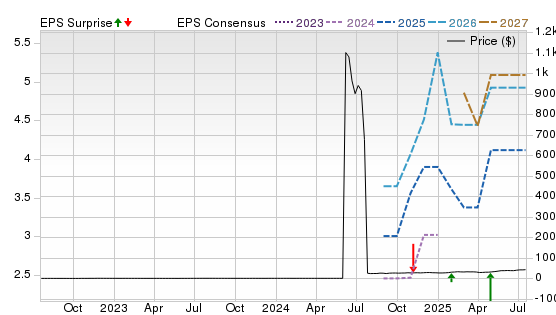
A Zacks Rank #3 with A scores for Value and Growth but F Momentum indicates fundamental appeal, though the market is not fully confirming it. The chart shows a low-priced stock base after relisting noise, consistent earnings beats and sharply rising 2025–2028 consensus lines. That estimate staircase is encouraging, but the flat share price argues for patience.
This is our short term rating system that serves as a timeliness indicator for stocks over the next 1 to 3 months. How good is it? See rankings and related performance below.
The Zacks Industry Rank assigns a rating to each of the 265 X (Expanded) Industries based on their average Zacks Rank.
An industry with a larger percentage of Zacks Rank #1's and #2's will have a better average Zacks Rank than one with a larger percentage of Zacks Rank #4's and #5's.
The industry with the best average Zacks Rank would be considered the top industry (1 out of 265), which would place it in the top 1% of Zacks Ranked Industries. The industry with the worst average Zacks Rank (265 out of 265) would place in the bottom 1%.
The Zacks Sector Rank assigns a rating to each of the 16 Sectors based on their average Zacks Rank.
A sector with a larger percentage of Zacks Rank #1's and #2's will have a better average Zacks Rank than one with a larger percentage of Zacks Rank #4's and #5's.
The sector with the best average Zacks Rank would be considered the top sector (1 out of 16), which would place it in the top 1% of Zacks Ranked Sectors. The sector with the worst average Zacks Rank (16 out of 16) would place in the bottom 1%.
The Style Scores are a complementary set of indicators to use alongside the Zacks Rank. It allows the user to better focus on the stocks that are the best fit for his or her personal trading style.
The scores are based on the trading styles of Value, Growth, and Momentum. There's also a VGM Score ('V' for Value, 'G' for Growth and 'M' for Momentum), which combines the weighted average of the individual style scores into one score.
Value ScoreA
Growth ScoreA
Momentum ScoreA
VGM ScoreA
Within each Score, stocks are graded into five groups: A, B, C, D and F. As you might remember from your school days, an A, is better than a B; a B is better than a C; a C is better than a D; and a D is better than an F.
As an investor, you want to buy stocks with the highest probability of success. That means you want to buy stocks with a Zacks Rank #1 or #2, Strong Buy or Buy, which also has a Score of an A or a B in your personal trading style.
Zacks Earnings ESP (Expected Surprise Prediction) looks to find companies that have recently seen positive earnings estimate revision activity. The idea is that more recent information is, generally speaking, more accurate and can be a better predictor of the future, which can give investors an advantage in earnings season.
The technique has proven to be very useful for finding positive surprises. In fact, when combining a Zacks Rank #3 or better and a positive Earnings ESP, stocks produced a positive surprise 70% of the time, while they also saw 28.3% annual returns on average, according to our 10 year backtest.
United Airlines is a network carrier pursuing a brand-loyal, premium-focused model across hubs and global routes. Its strategy should benefit from improved digital merchandising, expanded MileagePlus incentives, planned premium A321 Coastliner and XLR cabins, Signature Interiors, Starlink and fuel-efficient aircraft deliveries, while capacity discipline on marginal flights may support fuel-cost recovery, stronger customer choice and management’s target of double-digit pretax margins ahead.
Potential Risks
Elevated jet fuel, demand elasticity from higher fares, capacity cuts pressuring unit costs, geopolitical disruption, weather events and FAA constraints at O’Hare could hurt performance.
Forecast
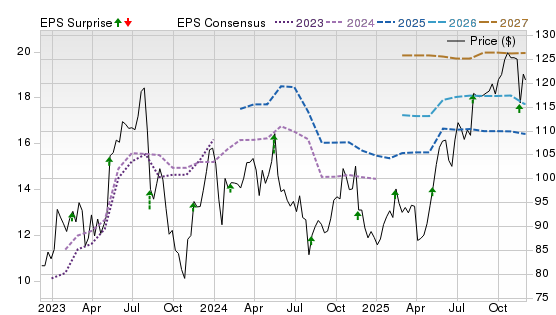
A Zacks Rank #3, A scores for Value and Growth and C Momentum point to a reasonably priced cyclical with solid earnings power but less decisive price strength. The chart shows a sharp rally with several positive surprises. The 2026 estimates are volatile, yet the 2027–2028 consensus lines rise. Further upside is likely to require smoother revisions and sustained operational execution.
The Zacks Rank is a proprietary stock-rating model that uses trends in earnings estimate revisions and earnings-per-share (EPS) surprises to classify stocks into five groups: #1 (Strong Buy), #2 (Buy), #3 (Hold), #4 (Sell) and #5 (Strong Sell). The Zacks Rank is calculated through four primary factors related to earnings estimates: analysts' consensus on earnings estimate revisions, the magnitude of revision change, the upside potential and estimate surprise (or the degree in which earnings per share deviated from the previous quarter).
Zacks builds the data from 3,000 analysts at over 150 different brokerage firms. The average yearly gain for Zacks Rank #1 (Strong Buy) stocks is +24.00% per year from January, 1988, through May 4, 2026.
Selections for Best Airline Stocks are based on the current top ranking stocks based on Zacks Indicator Score, Style Scores and fundamentals. All stocks have a daily trading volume of at least 100,000 shares and has a stock price of at least $5. All information is current as of market open, June 19, 2026.
General Questions About Airline Stocks
What are the benefits of buying airline stocks?
Exposure to global travel growth.
Operating leverage during economic expansions.
Pricing power during peak travel seasons.
Potential turnaround opportunities after downturns.
Consolidated U.S. industry with limited major competitors.
For example, legacy carriers like American Airlines Group (AAL - Free Report) and United Airlines Holdings (UAL - Free Report) control extensive route networks and benefit from international travel rebounds.
Low-cost carriers such as Southwest Airlines (LUV - Free Report) and Spirit Airlines (SAVE - Free Report) offer leaner cost structures that can outperform during certain demand cycles.
What are the risks of buying airline stocks?
High fuel-price exposure.
Sensitivity to recessions.
Heavy debt loads.
Labor and union cost pressures.
Weather and operational disruptions.
Geopolitical events impacting travel demand.
Airlines often carry substantial debt because aircraft fleets require significant capital investment. That leverage magnifies both gains and losses.
Airline Stocks vs Airline ETFs
If you prefer diversification, airline-focused ETFs may offer broader exposure than a single stock.
For example, the U.S. Global Jets ETF (JETS - Free Report ) holds major U.S. airlines along with international carriers and aircraft manufacturers.
Single stocks may offer higher upside if you pick a top performer, but ETFs reduce company-specific risk.
Do airline stocks pay dividends?
Some airlines historically paid dividends, but payouts were largely suspended during the pandemic. While certain carriers are rebuilding balance sheets, dividends are not yet widespread across the sector.
Investors typically buy airline stocks for capital appreciation rather than income.
How to Select Fundamentally Strong Airline Stocks
Choosing the best airline stocks requires analyzing more than passenger growth headlines.
Key fundamentals to evaluate include:
Debt-to-equity ratio.
Free cash flow generation.
Fuel-hedging strategy.
Cost per available seat mile (CASM).
Revenue per available seat mile (RASM).
Load factor trends.
Fleet age and efficiency.
Carriers investing in fuel-efficient aircraft may have a competitive edge when oil prices rise.
How can I analyze an airline stock’s potential?
Start by reviewing:
Revenue growth trends (domestic vs international mix).
Profit margins relative to peers.
Capacity expansion plans.
Management guidance.
Analyst consensus estimates.
Exposure to premium travel vs leisure travel.
For example, Alaska Air Group (ALK - Free Report) has historically focused on operational reliability and West Coast routes, while JetBlue Airways (JBLU) emphasizes value-oriented routes and customer amenities.
International exposure can also diversify revenue streams. European carrier Ryanair Holdings (RYAAY - Free Report ) is known for its ultra-low-cost model and cost discipline.
Market Condition Questions About Airline Stocks
Are airline stocks recovering?
Airline stocks have rebounded alongside travel demand recovery, especially in leisure and international routes. Profitability depends on maintaining pricing strength while managing fuel and labor costs.
Corporate travel trends remain a key variable, as business travelers typically generate higher margins.
Are airline stocks a good long-term investment?
Long term, airlines tend to grow in line with GDP and global travel trends. However, returns can be uneven due to industry cyclicality.
Investors seeking steady compounding may prefer airlines with stronger balance sheets and diversified route networks.
Should I buy airline stocks during a recession?
Airline stocks often decline sharply during recessions because travel demand falls. However, downturns can create attractive entry points for long-term investors willing to tolerate volatility.
Historically, the best returns often came from buying during periods of pessimism — but timing requires patience and risk tolerance.
Risk and Volatility of Airline Stocks
Why are airline stocks so volatile?
Airlines operate with:
High fixed costs.
Thin margins.
Exposure to commodity prices.
Economic sensitivity.
Small changes in ticket pricing or fuel costs can dramatically impact earnings.
Are airline stocks risky?
Yes — compared to many other sectors. They are considered cyclical and economically sensitive investments.
However, risk varies by business model. Ultra-low-cost carriers may be more resilient during budget-conscious travel periods, while premium-focused airlines may perform better in strong economies.
What are the biggest risks of investing in airline stocks?
Oil price spikes.
Economic downturns.
Excess capacity.
Competitive pricing wars.
Labor disputes.
Regulatory changes.
Why do airline stocks drop when oil prices rise?
Fuel is one of the largest operating expenses for airlines. When oil prices rise, jet fuel costs increase, squeezing profit margins unless ticket prices rise fast enough to offset the expense.
Airlines with fuel-hedging programs or more efficient fleets may soften the impact.
How do recessions affect airline stocks?
Recessions reduce discretionary spending and business travel. Load factors decline, pricing weakens, and airlines may reduce capacity.
Because of high fixed costs, even modest declines in demand can lead to outsized earnings pressure.
How do you invest in airline stocks?
You can invest through:
Individual airline stocks.
Airline-focused ETFs.
Broader transportation or industrial ETFs.
Mutual funds with airline exposure.
Investors should consider risk tolerance, time horizon, and portfolio diversification before allocating capital.
Is it better to buy one airline stock or diversify?
Owning one airline stock can offer higher upside if that company outperforms. However, diversification reduces company-specific risks like operational disruptions or management missteps.
For example:
A portfolio holding Delta Air Lines (DAL) for premium exposure.
Southwest Airlines (LUV) for domestic low-cost exposure.
And Ryanair Holdings (RYAAY) for international diversification.
Alternatively, the U.S. Global Jets ETF (JETS) provides one-click exposure to the broader airline ecosystem.
Final Thoughts
The best airline stocks can deliver powerful gains when travel demand is strong and capacity is disciplined. But they are inherently volatile, sensitive to oil prices, and heavily tied to economic cycles.
For investors comfortable with cyclical swings, airline stocks may offer tactical opportunities — especially during industry recoveries or economic rebounds. For others, diversified exposure through ETFs may provide a smoother ride.
As always, balance growth potential with risk management when investing in this high-flying sector.




 View the Zacks #1 Rank List


 Hold
Hold